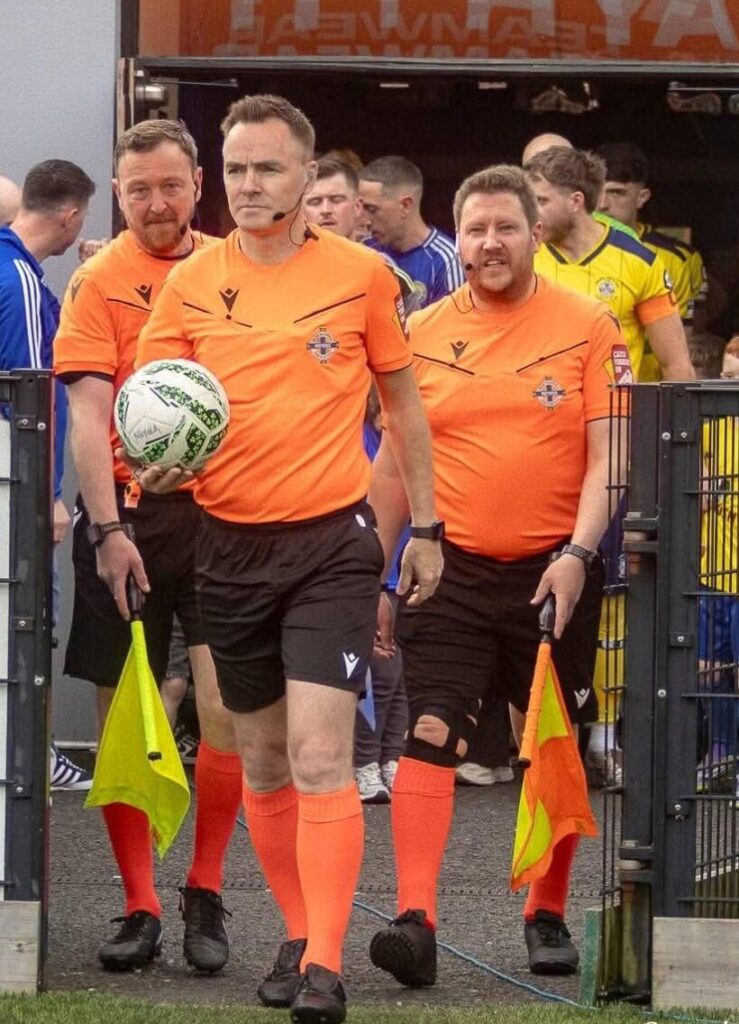
For our next Referee Spotlight, we catch up with Jamie Uprichard, whose journey from player to match official highlights the dedication, preparation and resilience required to referee at a high level.
What made you take up refereeing?
This is probably the most frequent asked question I receive. I played football in the Mid Ulster League and old Premier Intermediate League for a fair few years. Towards the end of my career, I guess I fell out of love a bit with the game. I’d always had a view on refereeing when I played (as many of my referee colleagues can testify) so I thought I had to step forward and give it a go. The very first evening at Windsor Park as part of the refereeing course I quickly realised that refereeing was much harder than I had anticipated. You hear plenty of views from players, team officials and spectators and I’d encourage them to try the course as they might realise (like I did) just how complex refereeing can be.
What has your refereeing journey looked like?
I can still remember my first game like it was yesterday. I was quite nervous as I wanted to do a good job. I recall being exhausted after the game. As a player you often switch off during play however as a referee you have to always concentrate for 90+ minutes. I think I fell asleep that night before 10pm! There is a steep learning curve to refereeing, including mastering the laws of the game but other areas such as communicating with players and managing the game were completely new to me – things I had never thought about.
In my first year, I was fortunate to have a good run in the Junior Cup, culminating in being the fourth official for the final at Shamrock Park in the first Covid affected season. I was promoted to intermediate standard soon afterwards before breaking my ankle playing over 35s football. On my return I had a few trials at PIL level and was promoted again at the end of the 2024/25 season. I have also been fortunate to officiate at the Super Cup NI, working with colleagues from across Northern Ireland and learning from senior colleagues.
What is your matchday preparation?
In my playing days, I think it’s fair to say that I imagined referees simply turned up before the game. However, the truth is much difference. Our fixtures are generally allocated on a Monday and that’s when the preparation starts. You research both sides, looking at form, past results etc. You may look who officiated previous games and message them to see how it went. Teams are expected to add their colours to Comet in advance of matchday. This enables a decision on what colour of kits the match officials will wear. On a Thursday, I ensure my comms kit is fully charged and all kit including matchday attire is washed and ready. I am generally in contact with both assistants to arrange our meeting time on the Saturday. I pack my bag on a Friday night. Saturday mornings consist of porridge and coffee, a quick refresh of the Laws of the Game and check of my notes before making my way to the game. We will meet 1 hr 30 before the game to discuss expectations and our approach. In between times there also senior panel meetings at Windsor Park, Mid Ulster Referee’s Association meetings to help with learning and development and training to stay fit.
What are the main challenges you face in your role?
I’d say the high expectations I set myself. I have to be honest, I didn’t realise refereeing was so complex – applying the laws of the game accurately, game management, communication with players and team officials, being in the right position to make the right call. Referees make mistakes – it’s inevitable as no-one is perfect but we aim to ensure that we get significantly more decisions right than wrong, learn from our mistakes, and constantly look for ways to improve. Every game presents different challenges and situations, so there is always something new to learn. It goes without saying that you need to be resilient. Referees receive considerable challenge and at times this can boil over into abuse. While I understand the emotion in the game – it’s the beautiful game after all, this is a challenge to refereeing and ensuring that we recruit and retain talented referees for the future.
What does your life look like outside of football?
I work in Economic Policy and Strategy, and unfortunately this takes up more time than it used to. My free time nowadays is generally spent as a taxi driver for my two dance mad daughters, who are growing up too fast! I enjoy travelling and am happiest when cruising with the family – availing of the drinks package, eating in the restaurant, lying on a sun lounger or at the theatre. I’m one of the circa 9,000 type 1 diabetics in Northern Ireland and am excited about the opportunity to receive a wireless insulin pump in the near future. It’s part of a HCL – Hybrid Closed Loop that connects to my Continuous Glucose Monitor (a sensor in my arm) which tells how much insulin to inject based on my blood sugar levels. Effectively an artificial pancreas! Being a diabetic, I’ve had to make a few adjustments, particularly around pre-match nutrition, but it generally doesn’t impact my refereeing. I recently swapped the football pitch for the dancefloor by taking part in a Strictly Come Dancing challenge, raising funds for Diabetes UK. It’s probably the only time I’ve run out to chants of “The Referee’s a dancer!” rather than the alternative, which made for a pleasant change!
Have you any advice for new referees or someone considering it?
I’d recommend that younger people look into and consider refereeing – there are amazing development opportunities if you are keen. I would also encourage ex-players to explore a different side of the game. I used to think I’d end up coaching, but refereeing presented a steep learning curve that, once I started, I got completely hooked on. Besides, it’s nice to finally understand what referees are thinking when players tell them they’re wrong!
Refereeing also provides transferrable skills – giving opportunities to develop as a leader, communicator and decision-maker, both on and off the pitch.
What are your favourite grounds to referee at?
I really enjoy seeing local clubs enhance their facilities. Tandragee Rovers has easily one of the best playing surfaces in local football. I enjoy officiating at Warrenpoint Town as you are always looked after with plenty of treats – cups of tea, buns, soup, wheaten bread etc. The referee room at Ballymacash Rangers is probably the most extensive, although the décor at Crewe United deserves a special mention. Personally, I enjoy trips up to the north coast to officiate at Portstewart – well beyond the Mid Ulster boundary!
What new rule (or law) would you introduce?
While the constant changes to the laws of the game can feel like tinkering at times, the introduction of the 10 second count-down for substitutes or 5 seconds for goal kicks and throw-ins (when teams are obviously delaying the restart) has helped cut down on time wasting. The introduction of players having to leave the field of play if they receive treatment, means that physios rarely come onto the pitch these days. Personally, I dislike VAR – although (for referees) I can appreciate the benefits of being alerted to a clear and obvious error. For me, I’d introduce a warning for players stealing yards at throw-ins. Perhaps a warning initially and then the throw goes to the other team if its (blatant and) repeated. Perhaps the introduction of a sin bin to counter the rise in dissent. This could prove to be a more meaningful deterrent should teams be temporarily reduced in number rather than the player being cautioned.